
The Texas State Emergency Operations Center (SOC), operated by the Texas Division of Emergency Management (TDEM), functions 24/7 to support statewide emergency response and coordination. The SOC monitors disasters and emergencies across Texas, facilitates the exchange of critical information with local, state, and federal partners, and coordinates state resources to assist local governments during disasters or significant events.
During major incidents, the SOC becomes a central coordination hub where the agency leadership, other state agencies, and volunteer organizations that make up the Texas Emergency Management Council convene to identify needs, mobilize resources, and deploy state and volunteer support to affected communities.
Additionally, the SOC serves as the state warning point.
The SOC is staffed around the clock by The Watch — TDEM’s dedicated team that ensures 24/7, year-round operational readiness. The Watch supports local jurisdictions by coordinating assistance for emergencies and special events across Texas. It typically manages over 8,000 incidents annually, distributing National Weather Service updates to affected regions, maintaining real-time situational awareness, and producing timely reports such as Incident Reports, Spot Reports, and Situation Reports. When necessary, the Watch increases readiness levels at the Governor's direction and notifies appropriate Texas Emergency Management Council members and TDEM personnel to ensure a swift and coordinated response.
During disasters and planned events, the SOC is activated to serve as the central coordination point for statewide emergency response. The SOC brings together members of the Texas Emergency Management Council, support personnel, and subject matter experts to manage response operations. Staffing levels and operational periods are determined by the scope and scale of the event.



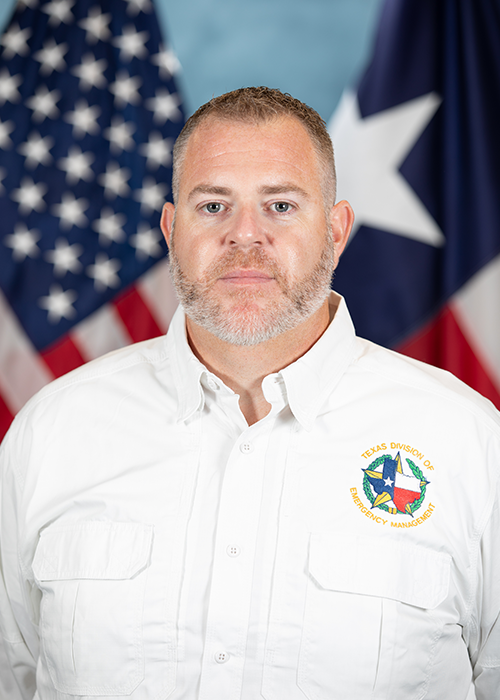
Aaron Alvarez is the Incident Support Task Force Coordinator for TDEM Region 5. He previously served as Executive Aide, working closely with the Media, Communications, and Preparedness teams and agency leadership to support public engagements and events across the state. He originally joined TDEM as Advance Representative.
Aaron is a graduate of the inaugural Texas Emergency Management Academy, where he received his FEMA National Emergency Management Basic Academy Certificate of Completion as well as NREMT Emergency Medical Technician Basic Certification. The Academy provided him with over 1,400 hours of instruction, training, and knowledge in a variety of aspects of emergency management, including the fields of emergency preparedness, disaster response, recovery, and hazard mitigation.
After graduating high school and attending college, Aaron worked as a project manager for a general contracting company in Austin, TX. During his free time, he spent many hours volunteering for the local Fire Department and learning about Fire and Emergency Services.

As soon as possible, all jurisdictional departments should begin gathering response costs and initial damage estimates. These figures need not be exact but are necessary to complete the Disaster Summary Outline (DSO). The DSO is the first snapshot TDEM receives regarding the extent of damages. The DSO is used as a basis for obtaining a Presidential Disaster Declaration. DSOs will automatically be sent to the State Operations Center (SOC) through the form.
All documents must be downloaded and viewed within a PDF Reader, such as Adobe Acrobat. If you do not have the Adobe Acrobat Reader, you can download it free of charge.
Download the Adobe Acrobat Reader
All documents must be downloaded and viewed within a PDF Reader, such as Adobe Acrobat. If you do not have the Adobe Acrobat Reader, you can download it free of charge.
Download the Adobe Acrobat Reader
Under Section 775.083 of the Texas Health and Safety Code, emergency services districts are required to file an annual report with the Texas Division of Emergency Management. The report is due by January 1 each year.
TDEM has arranged with the Texas State Association of Fire and Emergency Districts (SAFE-D) to collect the annual reports.
To view filings for the most recent year, click to: https://www.safe-d.org/esdreports26/
To submit a new/updated report use this link: https://form.jotform.com/253338697105160
For more information about SAFE-D visit: www.safe-d.org (or contact admin@safe-d.org).
Additional Information
STEAR Forms and Documentation


.png)
.png)